I want to start by saying something that I hope takes a little pressure off you right now. The fact that you are reading this means you are paying attention. You noticed. And in my years working with families navigating Parkinson’s disease, the people who pay attention are the people who do right by their loved ones. Sometimes a family calls me after a fall. Sometimes it’s after a scary medication moment, or after they’ve realized they haven’t slept a full night in weeks. Sometimes it’s just a quiet afternoon when a spouse looks across the table and thinks, I cannot keep doing this alone.
All of those moments are valid. There is no wrong time to start asking questions. Parkinson’s disease is not a straight line. Some days are better than others. Some weeks feel almost normal. But there does come a point, for most people living with this disease, where the symptoms shift in a way that changes what daily life looks like. Where tremors that were manageable before are now making it hard to button a shirt. Where the floor feels less steady. Where the person you love seems slower, quieter, more tired than they used to be.
That is the moment I want to talk to you about. Not to scare you. But because knowing what to watch for, and knowing what kind of help is out there, can make a real difference.
Early Signs That More Support Is Needed
Families usually start noticing the little things first. A shaky hand that used to be barely visible is now constant. Getting up from the couch takes effort. A favorite meal is left half eaten because holding a fork is just too tiring. These small shifts are worth paying attention to.
Balance Problems and Falls
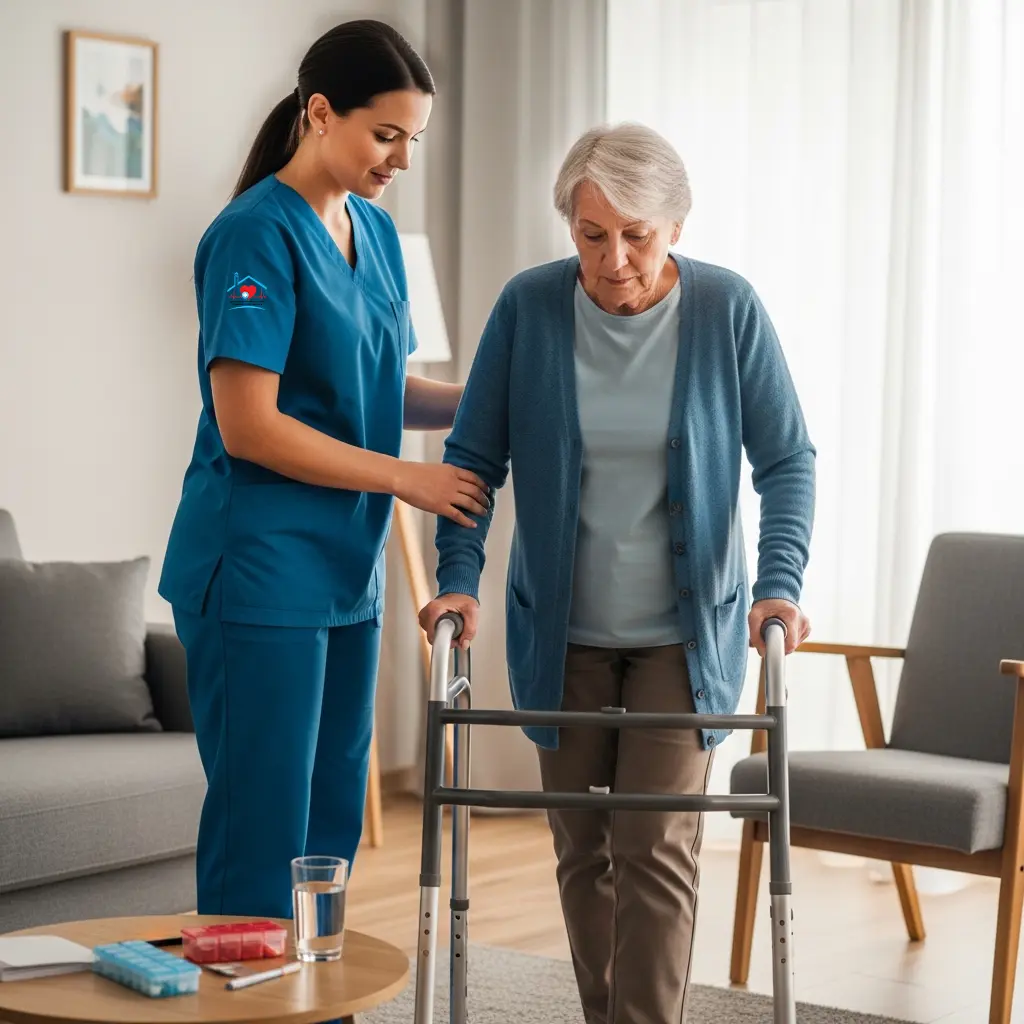
Balance changes are one of the earliest and most important signals that more help may be needed. Parkinson’s affects the way the brain communicates with the muscles, which means the body does not always respond the way the person expects it to. Steps get shorter. Turns get slower. The body starts to lean forward a little without the person even realizing it.
Falls become a real risk. And I say this not to frighten you, but because falls in older adults with Parkinson’s can be serious. A broken hip, a head injury, a long time spent on the floor before someone finds them. These are things we want to prevent before they happen. If your loved one has stumbled recently, or if you find yourself holding their arm more when you walk together, that is worth noting.
Medication Timing and Management
Parkinson’s medications, especially levodopa based ones, work in a very specific window. Take them too late, and symptoms can spike. Miss a dose and things can feel very different very quickly. I’ve seen this happen when a caregiver gets overwhelmed, or when the person with Parkinson’s starts to lose track of time or becomes confused about what they have already taken. Getting medications right is not a small thing. It is central to how well a person functions day to day.
Fatigue That Goes Deeper Than Tired
Parkinson’s is exhausting. The muscles work constantly just to maintain basic posture and movement. Add to that the mental effort of navigating tremors and stiffness all day, and by afternoon, many people are completely spent. Fatigue at this level changes everything. It changes the ability to participate in therapy, to socialize, to eat well, to stay safe. When a family tells me that their loved one sleeps most of the afternoon and then is up confused at night, that pattern tells me a lot about where things are.
Cognitive Changes
Not everyone with Parkinson’s develops dementia, but cognitive changes are common. Slower thinking. Word finding difficulties. Some confusion, especially in the evening, which is sometimes called sundowning. Difficulty making decisions that used to feel simple. These changes can be gradual. But they affect how safely a person can be left alone, and how much support they need throughout the day.
When Safety Becomes a Concern
I want to talk about safety gently, because I know that word can feel heavy. It can feel like it signals the end of something, or like you are giving up some of your loved one’s independence. That is not what I mean.
What I mean is this: there are moments when the risk of something happening, a fall, a missed medication, a kitchen accident, starts to outweigh the benefit of trying to manage everything without help. And that is simply a practical reality, not a judgment.
Some things I hear from families that tell me we are at that threshold:
- I cannot leave him alone to go grocery shopping.
- She had another fall last week, and this time I was not home.
- He left the stove on twice this month.
- I haven’t slept through the night in six months.
These are real signals. They are not weak. They are information. When a caregiver is stretched past their limit, two people are at risk, not one. The person with Parkinson’s, and the person caring for them.
How Home Health Care Steps In
When Parkinson’s disease requires home health care, the goal is not to take over someone’s life. It is to fill in the gaps where the disease is making things harder, so the person can stay safe, stay comfortable, and stay in the place they know best.
Home is meaningful. It is where someone’s routines are. Their chair. Their photos. Their sense of who they are. When we can keep someone in their home safely, that matters.
A home health nurse typically starts with an assessment. We walk through the home. We look at what is working and what is not. We talk with the person and the family together, because both of those perspectives matter. Then we start to build a plan.
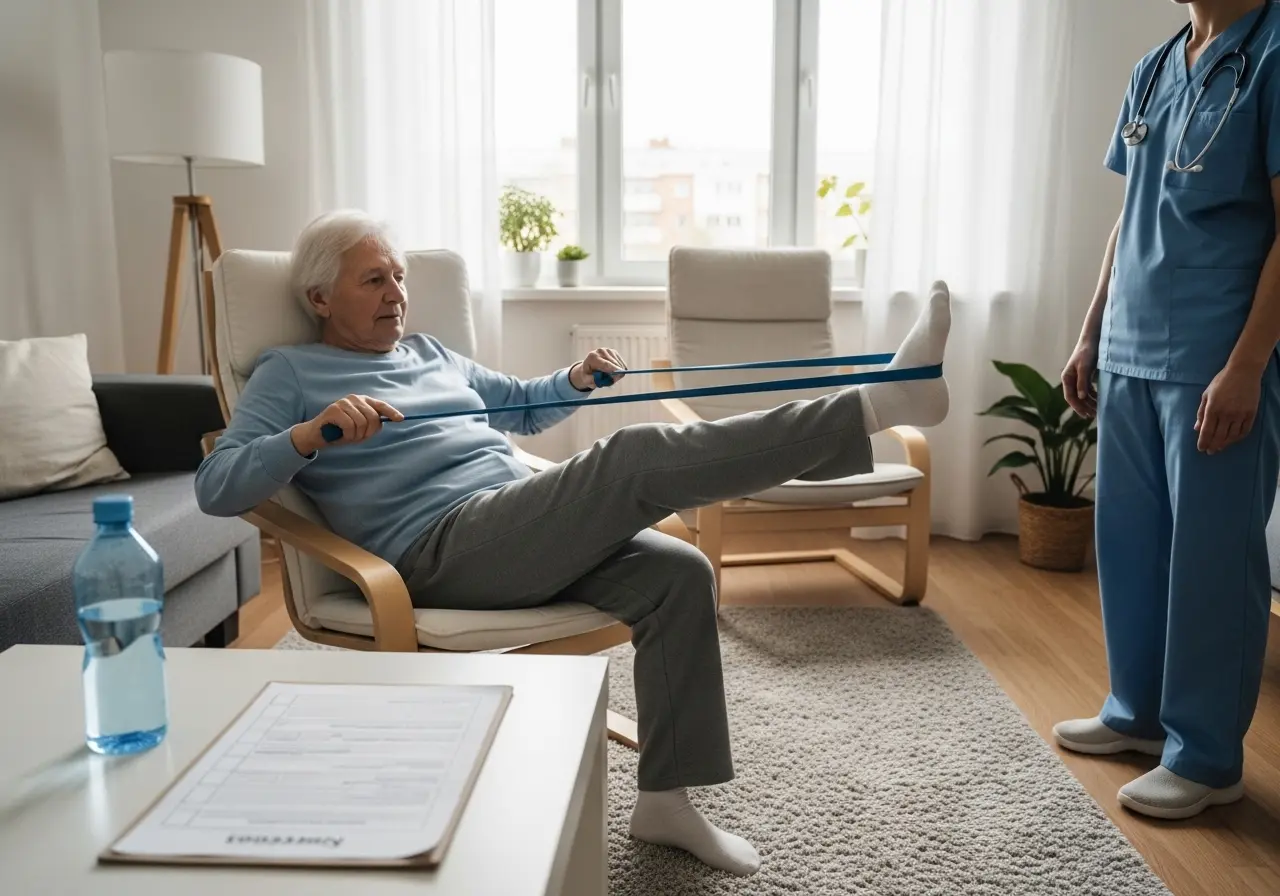
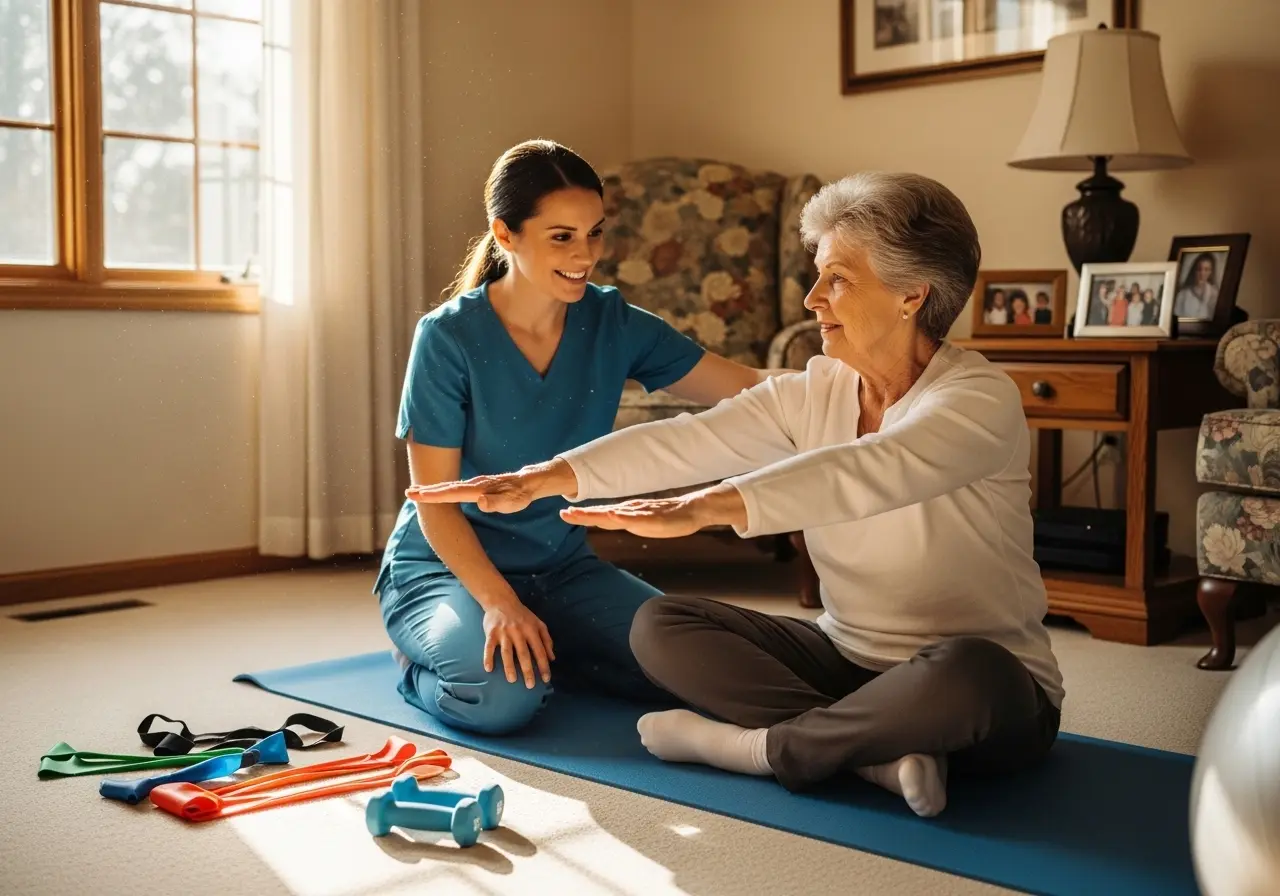
Depending on where someone is in their disease progression, home care for Parkinson’s can include skilled nursing visits, physical or occupational therapy, home health aide support, and coordination with the person’s neurologist or primary care physician. The pieces are put together based on what that specific person needs.
Because Parkinson’s disease requires home health care to be flexible, care plans tend to shift as symptoms shift. What someone needs at one stage may be very different six months later. A good home care team adjusts as things change.
Daily Living Support
This is the part of care that families sometimes feel the most conflicted about. Helping someone bathe. Helping them dress. Helping them eat. It can feel like a role reversal that is hard to navigate emotionally, especially for a spouse.
Daily living assistance for seniors with Parkinson’s is not about doing things for someone that they are capable of doing themselves. It is about meeting them where they are, and helping them stay as independent as possible within what their body will allow.
A home health aide learns how a person moves. What works for their morning routine. Whether they are steadier before or after their medication. How much time they need to get dressed without rushing, because rushing leads to falls.
Bathing safely is a real concern with Parkinson’s. The bathroom is where a lot of falls happen. Grab bars, shower seats, non slip mats, and someone there to help if needed, those things make the difference.
Eating can become difficult as the disease progresses. Swallowing changes are common in later stages, and a skilled nurse or therapist can help identify when those changes are happening before they become a choking or aspiration risk. Meal preparation, cutting food, and adapting utensils are all things that get addressed as part of everyday support.
Mobility help, whether that is getting in and out of bed, moving from a chair to a walker, or navigating stairs, is something aides are trained to do safely. It protects the person with Parkinson’s, and it protects the family member who might otherwise hurt their back trying to help.
Medication and Symptom Monitoring
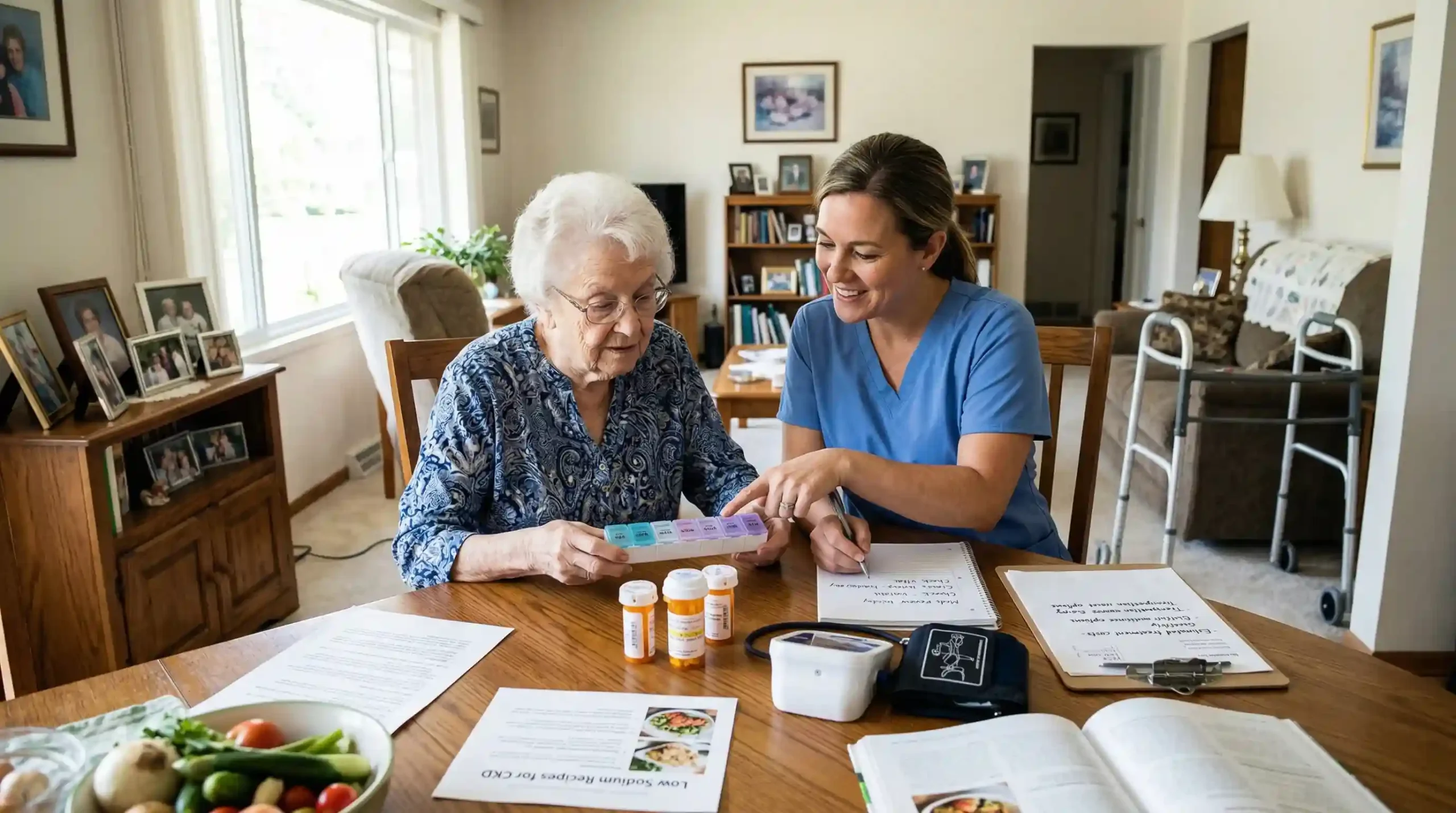
I said earlier that medication timing matters a lot with Parkinson’s. That is worth coming back to. A skilled home health nurse can help establish a medication schedule that works with the person’s daily rhythm. We make sure doses are not missed and not doubled. We watch for side effects. We notice when symptoms seem worse at certain times of day and report that back to the doctor.
Medication management for Parkinson’s is not set it and forget it. The disease progresses, medications get adjusted, and sometimes what worked well for a while stops working as well. Having a nurse involved means those changes get caught earlier, and the doctor gets the kind of detailed, day to day information that a brief office visit cannot always provide.
Symptom monitoring goes beyond medications too. We track changes in speech, changes in swallowing, changes in mood. Depression and anxiety are very common with Parkinson’s and often go under treatment. A nurse who is in the home regularly is in a position to notice those shifts and bring them to the team’s attention.
Personalized Care Plans
No two people with Parkinson’s are exactly alike. That sounds obvious, but it matters in practice. Personalized home care services are built around what one specific person needs, in their specific home, at their specific stage of the disease. Someone who lives alone has different needs than someone whose spouse is home all day. Someone whose main concern is fall prevention has different priorities than someone who is primarily struggling with medication management or mood.
A good care plan starts with a real conversation. What does a typical day look like? What are the moments that feel most difficult? What does the family need in terms of support? What does the person with Parkinson’s want, in terms of preserving their independence and dignity?
Those conversations shape everything that follows. And they happen again as things change, because what is personalized in month one may need to look different in month six.
When Families Compare Other Options
I would be doing you a disservice if I did not mention that home care is not the only path. Some families reach a point where they start looking at skilled nursing facilities near them, and that is a reasonable thing to consider.
Skilled nursing facilities in Illinois vary quite a bit in what they offer, the size, the staffing, the culture of the place. Some families find that the 24hour supervision, on site therapy, and medical oversight that a facility provides is the right level of care for where their loved one is. There is no shame in that. It is a legitimate option.
For families who are not sure whether home care or a facility is the better fit, I usually suggest asking these questions:
Can the person’s medical needs realistically be managed at home? Is there a caregiver who can be present, or available quickly, for the hours not covered by a home health aide? Does the person with Parkinson’s have strong feelings about staying home? And is the family caregiver, if there is one, sustainable in this role?
The answers to those questions guide the decision better than any general advice I could offer. A good home care team or a social worker connected to your loved one’s medical team can help you think through skilled nursing facilities near you alongside home care options, without pressure in either direction.
Insurance Questions
This comes up in almost every family conversation, and it can feel complicated. So let me keep it simple.
Medicare generally covers home health care when a physician certifies that a person is homebound and needs skilled nursing, physical therapy, occupational therapy, or speech therapy. Parkinson’s often qualifies under those criteria, particularly as the disease progresses. Coverage is for skilled services, not ongoing personal care or custodial care.
In home health care insurance through private policies varies widely. Long term care insurance, if a person has it, may cover home health aide hours and personal care that Medicare does not. It is worth pulling out that policy and reading it carefully, or having an insurance advisor help you understand what it covers.
Medicaid programs in Illinois have certain waiver programs that can help cover home care for people who qualify based on income and level of need. This is worth exploring if Medicare and private insurance do not fully cover what is needed.
I always encourage families to ask these questions directly with the home care agency, because a good agency will help you understand your options and what can be billed to insurance versus what would be private pay.
Local Care Context
For families in Illinois, there is a range of home care support available across the state, from urban areas to more rural communities. Senior home health care in Illinois has grown significantly in recent years, partly because families increasingly want to keep their loved ones home as long as possible, and partly because the healthcare system has recognized that good home based care can prevent hospitalizations and emergency room visits.
For families in the southwest suburbs, home health care in Lemont, Illinois and the surrounding areas has become more accessible. If you are in that part of the state and not sure where to start, reaching out to your loved one’s neurologist or primary care physician for a referral is a reasonable first step. They often know which local agencies have experience with Parkinson’s specifically.
A Note on Local Support
Families across Illinois often reach a point where managing Parkinson’s alone becomes overwhelming. Valentine Home Health Care supports seniors at home by providing nursing oversight and daily assistance, helping families maintain safety and dignity as the disease progresses.
Common Questions Families Ask
How do we know it’s time?
Honestly, there is no single moment that announces itself clearly. What I usually tell families is this: if you are asking the question, you probably already have an answer somewhere inside. When caregiving is affecting your health, your sleep, your work, or your relationships, that is a signal. When your loved one has had a fall, or has been managing medications inconsistently, that is a signal. When safety concerns are keeping you up at night, that is a signal worth acting on. Starting with a home health assessment does not commit you to anything. It gives you information. And information helps you make a clearer decision.
Can home care prevent a nursing home placement?
Sometimes yes, sometimes no, and I want to be honest about that because I think false promises do not serve anyone. For many people, good home health care, consistent skilled nursing support, fall prevention, medication management, and daily living assistance, does allow them to stay home significantly longer than they would have otherwise. That is real and it is common. For others, the disease progresses to a point where the level of care needed around the clock exceeds what can safely be provided at home, regardless of how much support is in place. That is not a failure. That is the nature of a progressive disease, and recognizing it in time allows for a planned, dignified transition rather than a crisis driven one.
What if symptoms suddenly get worse?
Call the doctor first. Sudden changes in Parkinson’s symptoms, a dramatic increase in confusion, a sudden inability to walk, severe tremors, can sometimes indicate something else going on. A urinary tract infection, a medication interaction, another illness entirely. These things can look like a rapid progression of Parkinson’s when they are actually a treatable problem. If there is already a home health nurse involved, call them too. Part of what we do is help sort out what is happening and whether it warrants an urgent care visit or something that can wait for a scheduled appointment. That kind of guidance is genuinely useful in a scary moment.
Is home health care covered by insurance?
As I mentioned earlier, Medicare covers skilled home health care when the criteria are met, which often applies for people with Parkinson’s at certain stages. Long term care insurance policies vary, but many do cover home care hours. Medicaid waiver programs in Illinois may provide additional coverage for qualifying individuals. The insurance landscape can be confusing to navigate, but a home care agency should be willing to help you understand what applies to your situation before you commit to anything.
What does a home health nurse actually do during a visit?
It depends on where in the care plan you are, but a typical skilled nursing visit might include checking vital signs, reviewing medications, assessing for any new symptoms or changes, doing a safety walk through of the home, communicating with the physician about anything concerning, and talking with the family caregiver about what they are seeing and what they need. Visits are also just conversations. How has this week been? What is worrying you? What is going better than expected? Those conversations matter. They are how we catch things early.
What if my loved one resists help?
This is one of the most common things families bring to me, and it is a real challenge. Many people with Parkinson’s, especially those who have been independent their whole lives, do not want to accept help. They may feel embarrassed, or angry, or like accepting care means giving up. I have found that starting small helps. A few hours a week. A specific task, like medication support or help with a shower. Not framing it as permanent, but as trying it out. And giving the person with Parkinson’s as much control over the decisions as possible, because that sense of control matters. Sometimes it helps to have the conversation initiated by the doctor rather than the family, since it can feel less like pressure and more like a recommendation. And sometimes it just takes time and a few more difficult days before someone is ready to accept help. That is okay. Keep the door open.
Can I still be the primary caregiver if home health is involved?
Yes. Absolutely. Home health care is not meant to replace you. It is meant to support you. The family caregiver remains the most important person in this. You know your loved one. You know their history, their personality, what they like, what upsets them, what gives them comfort. A home health team works alongside you, not instead of you. What changes is that you are not carrying everything alone. You have someone to call when you are not sure if a symptom is concerning. You have someone who can handle the shower on the mornings that are hardest. You have a little breathing room, which matters more than most people realize until they have it.
You Do Not Have to Figure This Out Alone
If you have made it to the end of this, you are someone who is thinking carefully about the person you love. That comes through even in a question like this, in the willingness to read and learn and consider.
Parkinson’s disease is hard. It changes over time in ways that require constant adjusting. And the families who are managing it at home are doing something genuinely difficult, day after day.
Home care does not fix the disease. Nothing does. But when Parkinson’s disease requires home health care, what it can do is make the hard days more manageable, keep your loved one safer in the place they know best, and give you a little of yourself back in the process.
You do not have to have it all figured out before you make a call. You just have to be willing to ask the first question. The rest can unfold from there. Read more